“Intramuros is the Philippine’s Angkor Wat,” declared Carlos Celdran, one of Manila’s celebrated walking tour guides.*** Take Carlos Celdran's walking tours and see Manila in a different light. Check out his blog at this link.
Wow, I thought. And my friends and I were wondering where to get money to visit the magnificent stone temples of Angkor Wat in far away Cambodia, when all along there exists stone-walled Intramuros in our beloved Manila.
My friend Jao would’ve loved this tour. She who always wonders why backpackers rarely come to Manila, and concludes that one reason is we don’t have enough “culture” to attract them. Now, here was this flamboyant guide Carlos saying Manila abounded in culture – when once upon a time Manila was the first-world city of Asia, thanks to the Americans – except that the spirit of glorious Manila died when the city was bombed and shredded in the aftermath of World War II, also courtesy of the Americans. So what now, is the real Manila still alive or dead?
As a resident of Manila, I live on its fringes, and rarely come down to visit Intramuros. Intramuros for me was for field trips, for occasional night outs with girlfriends, visiting the WOW Philippines exhibitions, and the occasional wedding. I used to wonder how it would feel for the people who actually live their lives within the Intramuros walls – surely, students who study in the schools around the area must feel more nationalistic when surrounded with the history of the Intramuros walls?
But such it is that we Filipinos rarely live and breathe history. We bemoan our lot, the lack of progress, the corruption of our officials, and we do our best to survive from day to day. Taking care of culture and history is not one of our primary goals. Even government does not prioritize the propagation of pride in our culture. The city of Manila tore down the historical Mehan Gardens, built by the Spaniards in 1858, to make way for a city college so more Filipinos could go abroad and earn a living.
"Before you can change how Manila looks, you have to change first how you look at Manila." For a few hours, Carlos Celdran takes you on a quick tour of the history of the Philippines, from the nipa huts of the pre-Spanish period, to the arrival of the Spanish, their importation of the stones used to build Intramuros, to the American colonization and to the aftermath of the Japanese occupation and WWII. And throughout that time, safe in the confines of what is now the Philippine’s oldest church, you are treated to a vision of how Manila was in those times. Your view of Manila changes. Yes, Manila has a soul. Yes, Manila has history, and she is alive and well for it.
Pride swells at such a thought. For a few brief moments, I am proud of my city. But at the same time, thinking of Celdran’s description of the ruin of Manila after World War II, I am sad too. It seems we never have risen from that fall, we have never regained our former glory. A few days later, eating at one of the little carinderias lined up along the Intramuros walls, I gather my thoughts. Yes, Intramuros may be steeped in history, but it is a history we choose to forget. Most of Intramuros has been reconstructed (San Agustin Church is the only authentic building still standing), and though we do try to evoke the beauty and mystery of Manila during the Spanish period, we can only look at Manila through rose-colored eyes for a few brief moments at a time. After a while, the intrusions of real life distract you -- from the abandoned warehouses within the fringes of the Intramuros walls, to the poorly maintained roads and the squalor of some of the houses just a few blocks from the grandiosity and romanticism of Manila Cathedral and San Agustin.
I can change the way I look at Manila, but I cannot turn a blind eye towards its other aspects. Manila lives and breathes, at times beautiful, at times frustrating. For what it’s worth, Celdran’s walking tour seeks to open us up to another aspect of Manila, and helps us see the history beneath the city from the vantage point of Intramuros. Intramuros then, is a temple that enshrines the history of what Manila had been. For this view alone, the tour is well worth its price.
Wednesday, May 09, 2007
Manila and the Days Gone By
An article written last year for a travel writing workshop. Yes, I attended a travel writing workshop. Yes, it was fun. And yes, the title probably sucks. :) But anyway, I'm still sharing this article, which has been described at some point as a bit depressing. Read on. :)

Manila - Frankenstein but Home
"...Frankenstein explains the city's visual style as well as its strength and resilience...Improvisation and cheerfully making do characterize the Filipino attitude toward poverty.
That poverty may be ubiquitous, but so is the energy. Teeming, corrugated-iron slums surround decaying Art Deco mansions. Lush bougainvilleas peek from behind high stone walls trimmed with barbed wire. Chapels hear confession in the middle of decadent shopping malls, and hand-painted billboards advertising movies like Brazen Women overlook vendors touting T-shirts that read JESUS OF NAZARETH. At stoplights, peddlers tap on your window proffering newspapers and Marlboro Reds, while children wave garish feather dusters and delicate lace handkerchiefs. And wherever you go, there is music, in the endless strips of "videoke" lounges, pouring forth from bars and clubs, and in the broken strains of a busker's ukulele. "
Thus Lara Day describes Manila in her article "The Bold and the Beautiful"*, featured in the May 7 issue of Time Magazine (Asia).
The article evokes mixed emotions for me. Pride, in having Manila featured somewhere. Sadness, disagreement, and yet in some parts, a rapid nodding of the head in concurrence, especially to that part regarding videoke. Heck, you can be in the middle of the remotest barrio in the country and still hear someone singing videoke. But still. The article describes Manila as hard to categorize -- there's no such thing as distinctly "Filipino", unlike Bangkok that has its temples, or Mumbai with its saris and spices. Instead, we have a Manila that is a mix of everything -- Frankenstein as the author describes it. Colorful, bold, but Frankenstein. And the beauty, as the author sees it, is not from that mish-mash of culture, nor from its people, but in the little things she struggles to see.
* Read the full article here.
Monday, May 07, 2007

Monday, April 16, 2007
Bantayan Island
After relaxing Malapascua Island, we proceeded to Bantayan Island for the second part of our vacation.
Bantayan is four hours away from Cebu City. The island itself is composed of 3 municipalities -- Sta. Fe, Bantayan and Madridejos on the northern tip. It is supposedly the "Egg Basket" of Cebu since it generates over one and a half million eggs a day to supply the growing demand of eggs for mainland Cebu, Negros, Panay and even Leyte.
Getting There
 To get to Bantayan Island, take the bus bound for Hagnaya from Cebu's Northern Bus Terminal. There are also non-stop aircon buses. Buses leave hourly.
In our case, we were travelling from Malapascua (in Cebu Island's northern most tip) to Bantayan. From Malapascua island, one can actually hire a boat straight to Bantayan Island. That costs around P1800-P3000 per boat, depending on the size of the boat.
Since we were only two people, we opted to ride the boat back to the town of Maya, from where we can take the bus back to Hagnaya. But, since the bus at Maya was to leave a lot later then we thought, we rode a habal-habal (for-hire motorcycle) back to the town of Daang Bantayan, where we boarded the Cebu City-bound bus. We asked the bus conductor to drop us off at a place called Don Pedro, where one can either take the tricycle to the Hagnayan Wharf (P20 per head, P100 for the whole tricycle), or wait for the bus bound for Hagnaya Wharf.
At the Hagnaya Wharf, there are fast craft boats and roro ferries that travel to Bantayan Island. Fare is P134.50. Expect to pay around P5 for the terminal fee. And expect to be harassed by ferry barkers.
Accommodations
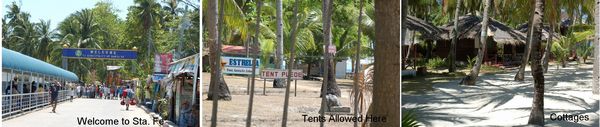
There are a lot of places you can stay in Bantayan. Some of the most pricey ones are Sta. Fe Beach Club and Ogtong Cave. Most accommodations are cottage-type. We had an aircon cottage. Try Kota Beach Resort or Budyong Resort beside it. Another famous one seems to be Sugar Beach. You can also opt to pitch a tent on the beach.
Things To Do
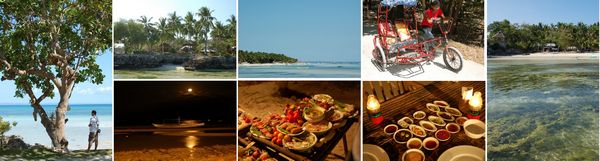
Like most beach towns, you can hire a boat and go snorkelling. Or you can walk along the whole beach area, from Ogtong Caves to the Bantayan Pier, and maybe even to the Sta. Fe Beach Club. You can try some overpriced seafood dining at White Sand Seafood Restaurant, where the view is nice. It seems though that the wind really picks up at night, so it's a bit hard to sip your sinigang when the wind is blowing the soup all over the place. There are also some species of birds that you don't normally see around Manila.
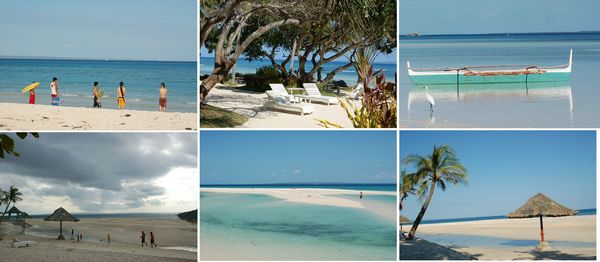
The sand bars are perfect for some skimboarding. You can fly kites, chase small crabs, play habulan, or just laze around the beach front. The tide usually rises around noon time, so it's actually more fun to swim around then. If you wait till sunset, the sandbars become more prominent, and you can walk for miles in shallow water.
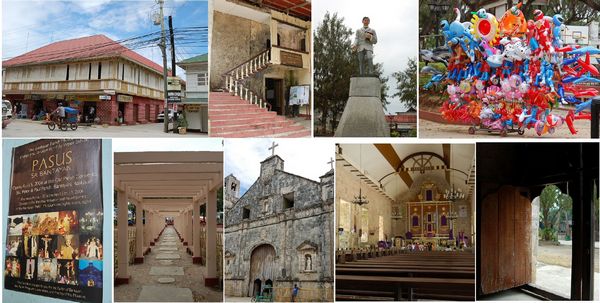
Ride a tricycle or multi-cab (smaller than a jeep) into the town proper of Bantayan to visit the Bantayan Market and the 400+ year old Bantayan Church. You can buy lots of dried squid, fish tocino and dried fish (danggit) in Bantayan Market. This is only around 30 minutes away from the Sta. Fe beaches. If you have more time, you can hop on a multi-cab to the town of Madridejos, and check out their board walk.
*** More pictures here: Multiply***
Bantayan is four hours away from Cebu City. The island itself is composed of 3 municipalities -- Sta. Fe, Bantayan and Madridejos on the northern tip. It is supposedly the "Egg Basket" of Cebu since it generates over one and a half million eggs a day to supply the growing demand of eggs for mainland Cebu, Negros, Panay and even Leyte.
Getting There
 To get to Bantayan Island, take the bus bound for Hagnaya from Cebu's Northern Bus Terminal. There are also non-stop aircon buses. Buses leave hourly.
In our case, we were travelling from Malapascua (in Cebu Island's northern most tip) to Bantayan. From Malapascua island, one can actually hire a boat straight to Bantayan Island. That costs around P1800-P3000 per boat, depending on the size of the boat.
Since we were only two people, we opted to ride the boat back to the town of Maya, from where we can take the bus back to Hagnaya. But, since the bus at Maya was to leave a lot later then we thought, we rode a habal-habal (for-hire motorcycle) back to the town of Daang Bantayan, where we boarded the Cebu City-bound bus. We asked the bus conductor to drop us off at a place called Don Pedro, where one can either take the tricycle to the Hagnayan Wharf (P20 per head, P100 for the whole tricycle), or wait for the bus bound for Hagnaya Wharf.
At the Hagnaya Wharf, there are fast craft boats and roro ferries that travel to Bantayan Island. Fare is P134.50. Expect to pay around P5 for the terminal fee. And expect to be harassed by ferry barkers.
Accommodations
There are a lot of places you can stay in Bantayan. Some of the most pricey ones are Sta. Fe Beach Club and Ogtong Cave. Most accommodations are cottage-type. We had an aircon cottage. Try Kota Beach Resort or Budyong Resort beside it. Another famous one seems to be Sugar Beach. You can also opt to pitch a tent on the beach.
Things To Do
Like most beach towns, you can hire a boat and go snorkelling. Or you can walk along the whole beach area, from Ogtong Caves to the Bantayan Pier, and maybe even to the Sta. Fe Beach Club. You can try some overpriced seafood dining at White Sand Seafood Restaurant, where the view is nice. It seems though that the wind really picks up at night, so it's a bit hard to sip your sinigang when the wind is blowing the soup all over the place. There are also some species of birds that you don't normally see around Manila.
The sand bars are perfect for some skimboarding. You can fly kites, chase small crabs, play habulan, or just laze around the beach front. The tide usually rises around noon time, so it's actually more fun to swim around then. If you wait till sunset, the sandbars become more prominent, and you can walk for miles in shallow water.
Ride a tricycle or multi-cab (smaller than a jeep) into the town proper of Bantayan to visit the Bantayan Market and the 400+ year old Bantayan Church. You can buy lots of dried squid, fish tocino and dried fish (danggit) in Bantayan Market. This is only around 30 minutes away from the Sta. Fe beaches. If you have more time, you can hop on a multi-cab to the town of Madridejos, and check out their board walk.
*** More pictures here: Multiply***
Bantayan Island, Cebu

After relaxing Malapascua Island, we proceeded to Bantayan Island for part 2 of our vacation.
Nagulat kami, roro pala yung boat papuntang Bantayan. And maraming tao! Lots of families. There were people just strolling along the beach, swimming, skimboarding, kiteflying, even playing frisbee!
Subscribe to:
Posts (Atom)
Popular Posts
-
One thing I just realized -- tamad na ako mag-blog. Tamad na naman, hehe. Pagalitan ako ni Bok nito eh. Tamad, tamad, puro na lang tamad. Ta...
-
 After relaxing Malapascua Island, we proceeded to Bantayan Island for the second part of our vacation. Bantayan is four hours away from Cebu...




 Posts
Posts

